PRESERVING CAPE HERITAGE AND CULTURE THROUGH EXPLORING VISUAL ARTS AND EDUCATION

HOERIKWAGGA CHRONICLES (DARL)
Beyond its status as a natural wonder, Table Mountain stands as a monument to human experience, a contested landscape of indigenous custodianship, colonial ambition, and enslaved resistance. Our digital library unearths the hidden narratives of those in the shadows, the marginalized such as the Khoe, San, and exiled communities who used its peaks, forests, and caves to preserve their heritage and resist oppression.
DIGITAL ARCHIVE RESEARCH LIBRARY (DARL)
By Yunus Ogier, OCTH Researcher
Table Mountain sits towards the southwestern corner of the western cape, and to a greater extent, Africa. The unmistakable silhouette of a flat topped sandstone massif at its highest point (Mclairs Beacon) rises 1086 meters above sea level. The first people (the local Khoe and San) had various names for Cape Town such as ||Hui !Gaeb (where the clouds gather), Camissa (the place of sweet water) and when referring to Table Mountain - Hoerikwagga (mountain in the sea) (Steenkamp 2026:7).
The UNESCO world heritage site has for millennia been woven into the landscape, playing witness to the indigenous people as they traversed its slopes, foraging for food and living close to the land. It stood firm during the 17th century when Dutch settlers arrived on the land, hoping to establish a permanent settlement. It has seen the influx of slaves from east Africa and the Indian ocean arriving on its shores, uncertain about what life awaits them.
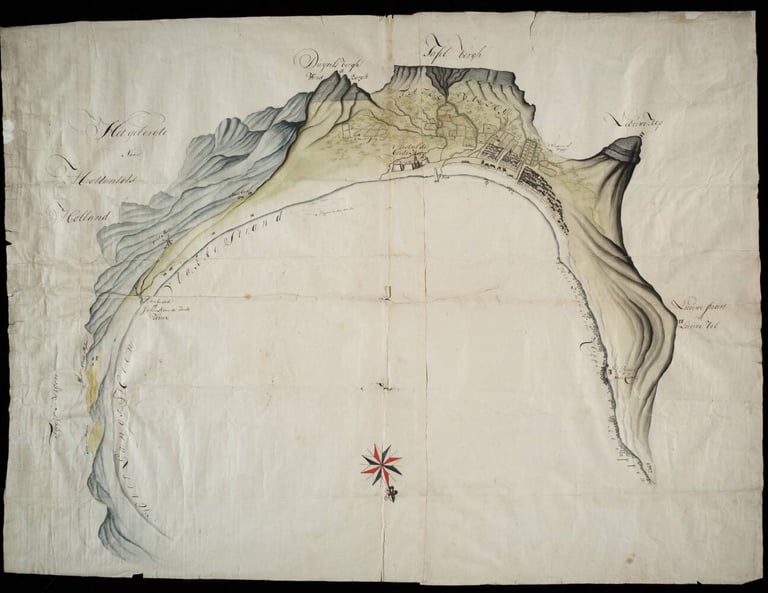
Figure 1. Undated rendering of Table Bay, image courtesy of the National Archives Netherlands
Today, the mountain and its various peaks overlook Cape Town, home to just under 5 million people (worldpopulationreview.com) and still it bears witness to a city, quite literally divided by a mountain. A familiar saying goes “die bruin mense bly oor die spoorlyn” (the brown people live across the railway line) - which, in vernacular geography referenced how spatial apartheid used infrastructure to segregate communities and control their modes of access (Sedite et al 2014:582). Table Mountain would be the natural variation of that railway line by which it divides the Cape flats from the inner city and the Atlantic seaboard. In current times, this division and the effects of spatial apartheid still influence how people engage with and respond to the mountain. It also affects who has access and how that access is controlled through remnants of apartheid. As SANParks states on its website “it is no longer an area for the privileged, but is open to all”. Yet the extent to which the mountain feels accessible to certain groups is a discussion for another time. This article, however, will showcase how Hoerikwagga has remained a symbol of power to the people of the Cape. It will also try to illustrate how varying groups — from settlers, colonizers, and the indigenous population, through to the enslaved — engaged with the mountain and the extent to which they exploited its resources.
The First Peoples and the Mountain
The first peoples to live in the Cape were the Khoe and San communities, Khoe being the pastoralist and the San being the hunter gatherers. Although two distinct groups, they viewed the land with a certain reverence, regarding it as a God given space where they are able to practice their religion. The land in itself was a gift from Tsui//Goab / ʹzu:ıʹgwa:b/ (their supreme being) and individuals could not own private land parcels, and that it had to be shared. From an ecological perspective, the Khoisan also practiced a form of fire stick farming, where controlled fires were set up to increase the yield of the Watsonia plant, which was high in carbohydrates. It remains uncertain if this method was practiced on the slopes of the mountain, but it does indicate how closely they were connected to the land and found ways to let it work in their favour (Boezak 2017:255, Poulsen 2013:41).
In the early days of the Cape, the mountain acted as an escape for those on the run, or for those who were avoiding work for the VOC. These drosters or deserters were known to flee to Table Mountain or hide in caves. The following text shows a confession being recorded by one such individual who tried to make his way towards “Cafferland”. It is not known if the figure was an enslaved or a marginal figure, however the testimony showcases some sort of ritual taking place : “licking with the tongue as with clean water…bound with white linen”, which suggests early indigenous rituals or rituals transplanted from east Africa or Madagascar.
The confessor tells of joining a group called the “Conspiracy” who travels around Table Mountain and the dunes, and it appears they even make their way to Hangklip. The confession is a first hand account of the bandieten or drosters who escaped VOC authorities. There is a possibility that this individual could not get far because after separating with the “Conspiracy”, he was captured again. This was possibly due to not knowing the landscape very well, or he most likely made his way back to the colony upon finding out he could not survive in the wilderness alone.
The European Settlers
To discover new trade links, so called voyages of discovery were undertaken by European countries, in the hope of finding the next commodity to exploit for their capital gain. Ships sailing towards the east would need to round the perilous Table Bay, synonymous for its storms. Therefore reward was given to the first sailor to spot Table Mountain as it meant they were nearing the shore. A prize of ten guilders and six bottles of wine was thus offered, which underscored how the VOC used alcohol as a means of control (Goetze 2002:459,460). The image of a flat topped rock taking shape on the horizon was a welcome sight for voyages who spent months at sea. The image quickly became popular with explorers and varying monikers have been applied to its likeness. It has been referred to as “De Windberg” by the Dutch whilst its sister peaks, that of Devils Peak and Lions Head were called “the alter” and “sugar loaf” respectively (Goetze 2002:460).
Surprisingly, even though the Dutch set up a refreshment station at the Cape in 1652, they were not as ambitious to conquer the mount, which was accomplished by Antonio de Saldanha, a Portuguese explorer and mountaineer in 1503 (Sittert 2002:162). However, the VOC, once settled, started militarizing the mountain and its surrounding environs by setting up little forts at Camps Bay, Hout Bay and Muizenberg in an effort to protect and defend a land they had only set foot upon (Sittert 2002:162). Upon exploring the area, specifically the Kloof between Table Mountain and Lions Head, van Riebeeck remarked:
“Beautiful, broad, fertile soil - as fine as one could find anywhere in the world”.
The commander had noted that during the dry season, the deepness of the cattle hooves indicated the hardness of the soil, and that in winter, the soil would accept the rainfall easily, making it sufficient for agriculture. He envisaged an idealist Dutch colony residing on the land and utilising the area around Table Mountain to sustain themselves in their agricultural projects (Pooley 2009:11).
Compared to the Portuguese, who didn't see much potential at the Cape (they had already secured outposts in Mozambique [Roque 2013]), the Dutch came to see much promise in the landscape. This could have possibly stemmed from the Netherlands having little land and having to extend its borders into the sea. Ultimately, the Dutch saw how well they could utilize the little space of the Cape peninsula and instead of treating the Cape as only a refreshment station, it could be turned into a full working colony and a means of accumulating state capital. This could have been one of the decisive factors in fortifying the peninsula so rapidly.
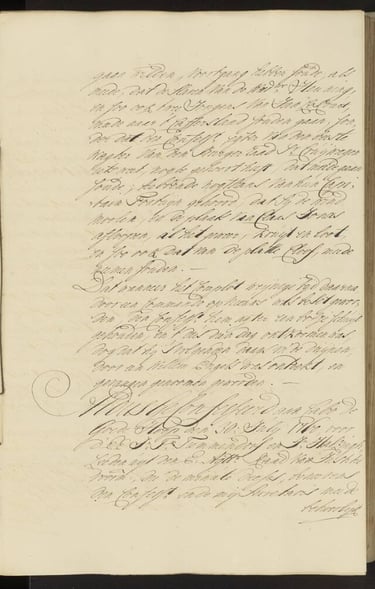
Figure 2. Image courtesy of the National Archives Netherlands
…September alvoorens soo door 't Lecken met de tong, als met schoon waater gesuijvert was, met wit linnen verbonden had, hebbende den Confesst dien nagt, ook aldaar ter plaatse, boven de backoven op de Kooij, en bij Jacob van Madagasm geslaapen, en naar den volgendag, nog aldaar verbleeven te sijn; is den Confesst op den Avond weederom daar van daan vertrokken, sig begeeven hebbende, naar de Tafelberg, alwaar hij het Complot in een hol weederom gevonden, en ook in 't selve een Nagt vertoeft heeft…Voorts verder duijnwaarts ingegaan sijn met voornemen, om hun naar de Hangklip te begeeven, om hun aldaar soo lang opte houden tot dat hunne groote rheijse naar Caffersland…
…September, having previously been purified by licking with the tongue as well as with clean water, and bound with white linen, the Confessor having slept that night, also there at the place, above the baking oven on the Kooij, and with Jacob from Madagasm, and to have remained there the following day; the Confessor departed from there again in the evening, having gone to the Tafelberg, where he found the Conspiracy again in a hole, and also stayed in the same for a night…furthermore, he went further dune-towards with the intention of proceeding to Hangklip, to keep them there until their great journey to Caffersland… (The Genealogical Society of South Africa,VOC letters and papers digital search, Globalise transcriptions viewer, inventory nr.10959.688)
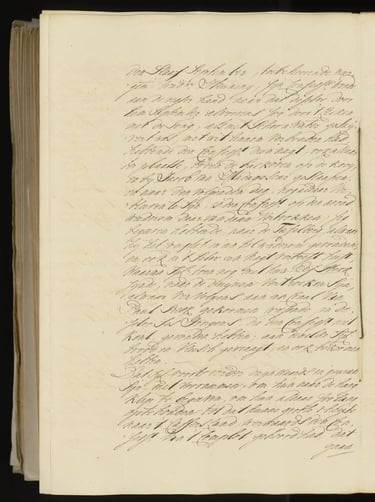
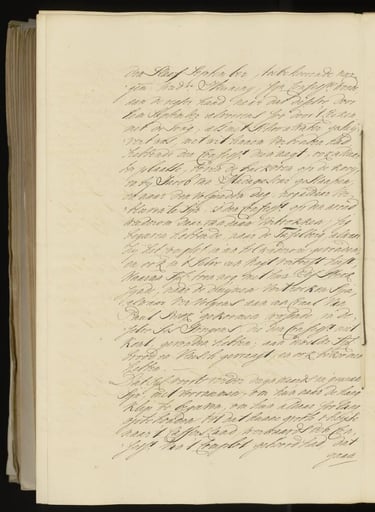
From the text, it appears that Aron of Madagascar is being questioned as part of a criminal case, and he is describing events that took place on Table Mountain. Another slave, by the name of Januarie, had told him that on Table Mountain there is a person by the name of Leander Boegies, and that money was exchanged to buy flints. The flints may have been used to start fires or for flintlock pistols. The whole exchange illustrates how active these groups were on the mountain. In addition to seeking refuge or fleeing their masters, it appears that it was also a space used to orchestrate possible revolts against the VOC.
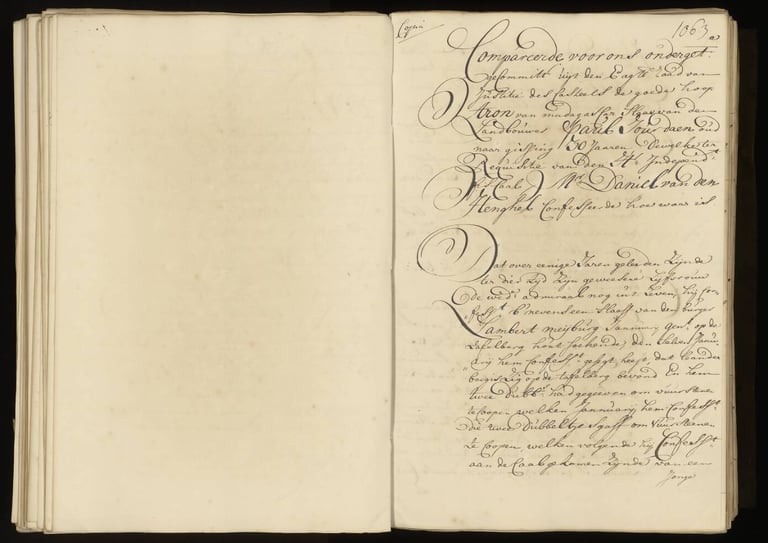
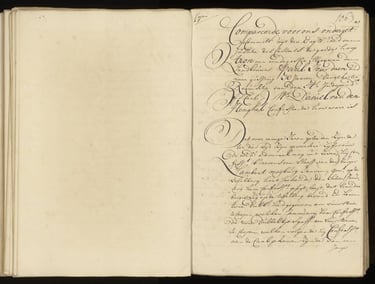
Figure 3. Image courtesy of the National Archives Netherlands
Hoerikwagga and the Indian Ocean slaves
During the mid 1600’s when slaves were being imported from the Asiatic regions, the mountain took on a new symbol of refuge for those being exiled. For the muslim slave population, the mountain became an active space of solitude, where those who were learned took it as a sign of tauheed (Oneness of Allah). Around the year 1750 there was a prophecy made by a certain Khardi Abdusalam, better known as Tuan Guru, who predicted that there will be a circle of saints which would surround the Cape all the way from Signal Hill to Zandvliet in Macassar (Cape Mazaar (Kramat) Society, 2010 , Tayob 2004: 78). In 1929, this notion was reiterated by Tuan Guru’s great - great grandson, who recounted to the Cape Times that the prophecy, now almost 260 years later, is complete. The article further illustrates this by stating:
From Signal Hill, round ZandVleit, Constantia, Bakoven and Robben Island, stretches a long line of kramats, the tomb of Tuans, or holy men of Islam, completing a vast circle within which, if the prophecy of Khardi Abdusalam 260 years ago is correct, all followers of the Prophet Mohammed will henceforth be safe from fire, famine, plague, earthquake and tidal wave (“A circle of Islam,” 1929, cited in Tayob:2004:78).
The oppressive VOC rule prohibited Islam to be practiced openly, which meant that adherents would secretly gather in the homes of the free blacks or in the forests on Table Mountain to practice their faith. These individuals were publicly identifiable from the core tenets which they held close to their traditions, which was shown through dress, behaviour and their artisanal skills (Morton 2020:138). Therefore the mountain not only symbolised tauheed, but its natural setting helped adherents practice their faith in a place that was monitoring social and religious practices very closely. The practice of a mountain being a place of sacredness directly ties back to Java where several mountain regions are either linked with the emergence of Islam or the adapting of Islam onto former Buddhist/ Hindu sites in Indonesia. “Mountainous Islam” or Islam Pegunungan is seen as an adaptive form of Islam in Indonesia that is dynamic and open to change (Salehudin et al 2017:152). There is a direct correlation on how Islam is practiced in the Cape which holds similarities to Islam Pegunungan. For example, in the region of Dieng in central Jawa (Jawa Tengah) the formation of pesantren (Islamic boarding schools) played important roles in the political, social and educational fields. There was the practice of memorizing Arabic and Islamic texts (including the Quran) and the unwritten rule that awliya (friends of Allah) were to be respected. In today's setting at the Cape, the veneration for the awliya could be interpreted as the visiting of tombs (kramats) and remembering their teachings. Politically, it was a foundation for anti-colonial rhetoric and the establishment of community leadership on a grassroots level (Salhehudin et al 2017:139, Ismah 2022:2).
The continuation of these traits at the Cape equipped the enslaved and the exiled Muslims to cultivate communal belonging and solidarity beyond the reach of colonial authorities. The madrassahs were seen as having a dual function in the early Cape as they operated as spaces of cultural preservation and spiritual resilience. Moreso by keeping alive Islamic practices and the reverence for the awliya and the intellectual traditions, the people of the Cape were able to resist assimilation into a colonial order.
The below excerpt once again outlines how the mountain was used as either a hiding place or where groups gathered to conspire against the VOC.
Compareerde voor ons ondergetekenden, gecommitteerden uit den Eerwaarden Achtbaren Raad van Justitie des Casteels de Goede Hoop, Aron van Madagassar, slaaf van den landbouwer Paul Jourdaen, oud naar gissing 30 jaaren, dewelke ter requisitie van den Heer Independent Fiscaal Mr. Daniel van den Henghel confesseerde hoe waar is. Dat over eenige iaren geleeden, zijnde ter dier tijd zijn geweesene lijfvrouw de weduwe admiraal nog in 't leven, hij confessor benevens een slaaff van den burger Lambert Meijburg, Jannuarij genaamd, op de Tafelberg hout soekende, den selven Jannuarij hem confessor gesegt heeft dat Leander Boegis zig op de Tafelberg bevond en hem twee dubbeltjes had gegeeven om vuursteenen te coopen. Welken Jannuarij hem confessor die twee dubbeltjes gaff om vuursteenen te coopen, welken volgende hij confessor aan de Caab gekomen zijnde van een...
Appeared before us, the undersigned, commissioned from the Honorable Council of Justice of the Castle of Good Hope, Aron of Madagassar, slave of the farmer Paul Jourdaen, aged by estimation 30 years, who at the requisition of the Honorable Independent Fiscal Mr. Daniel van den Henghel confessed how true it is: That a few years ago, his former mistress the widow Admiral being still alive at that time, he, the confessor, together with a slave of the citizen Lambert Meijburg named Januari, looking for wood on Table Mountain, the same Januari told him, the confessor, that Leander Boegis was on Table Mountain and had given him two dubbeltjes to buy flints, which Januari gave him, the confessor, the two dimes to buy flints, following which he, the confessor, having come to the Cape from a... (The Genealogical Society of South Africa,VOC letters and papers digital search, Globalise transcriptions viewer, inventory nr.4135.235).
In conclusion
The flat topped peak sitting in the southwestern corner of Africa has, through the centuries, seen how the local khoisan positioned themselves as custodians of the mountain. It has stood witness to explorers, settlers, and colonizers all wanting a piece of its landscape. The archival record has shown us that its slopes and forests were places of refuge for slaves and those wanting to practice their religion. Bandieten and drosters would meet in secret to possibly conspire against the VOC. Today the mountain is largely seen as a natural wonder with an abundance of trails meant for hiking and walking. However, its history is filled with indigenous belonging and colonial ambition. It holds remnants of religious struggles and enslaved resistance. To understand and to know the mountain is to recognize that Hoerikwaggo was not only meant for one community, but was a symbol of human experience throughout the Cape’s history.
Discover
Contact Us
Our cultural heritage matters
Help us learn and grow by sharing your respectful feedback on our website, exhibitions, social media and more:
Store's Terms and Conditions