PRESERVING CAPE HERITAGE AND CULTURE THROUGH EXPLORING VISUAL ARTS AND EDUCATION

FRA(U)GMENTED
DATE: 04 DECEMBER 2025 (OPENING AT 6PM)
EXHIBITION CLOSES 24 JANUARY 2024 (AFTER THE WALKABOUT)
VENUE: DESMOND AND LEAH TUTU LEGACY FOUNDATION
The Old Granary Building,
Buitenkant Street,
District Six, Cape Town, 8001
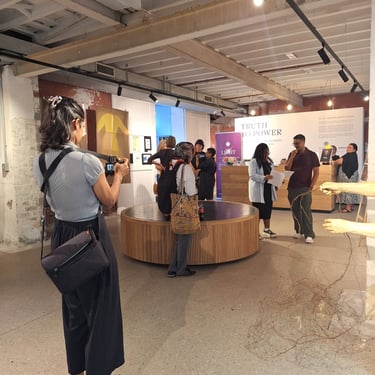
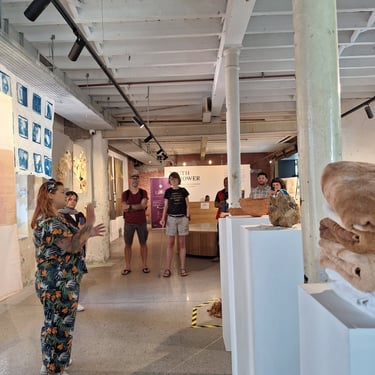
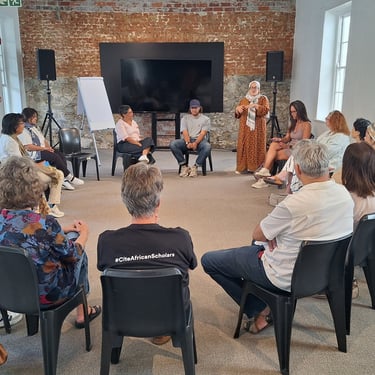
In collaboration with The Desmond and Leah Tutu Legacy Foundation, a Cape Town-based non-profit established to preserve and extend the legacy of Archbishop Desmond Mpilo Tutu and his wife Nomalizo Leah Tutu by nurturing courageous moral leadership, fostering healing from discrimination and conflict, and supporting programmes for societal justice and compassion. Among its flagship initiatives is the permanent exhibition titled Truth to Power: Desmond Tutu & the Churches in the Struggle Against Apartheid which invites visitors to explore Tutu’s global impact, his role in South Africa’s struggle against apartheid, and the values he promoted. The Foundation also uses this exhibition platform to engage learners, children and the broader public in dialogue about democracy, leadership and reconciliation.


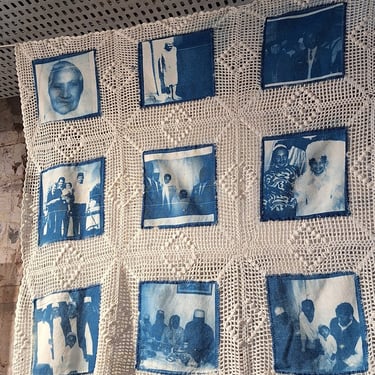
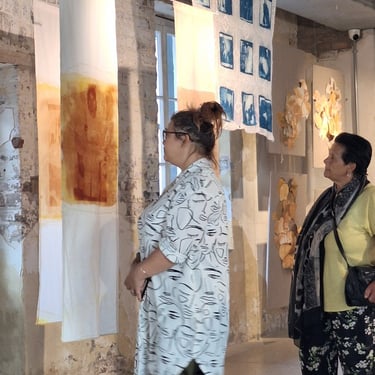
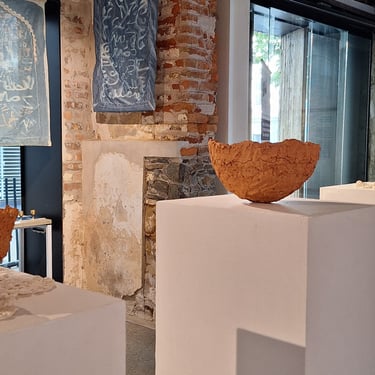
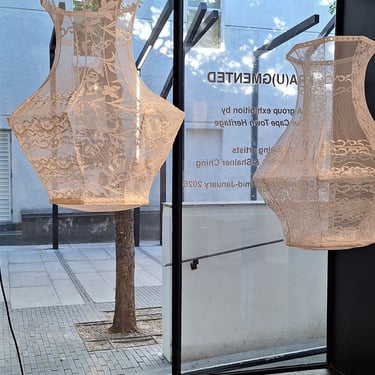
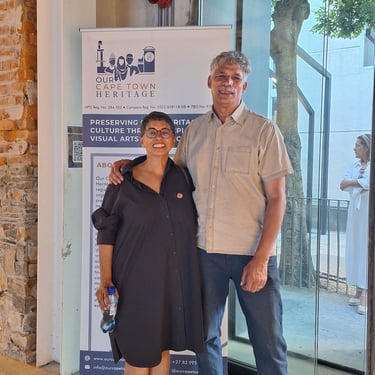
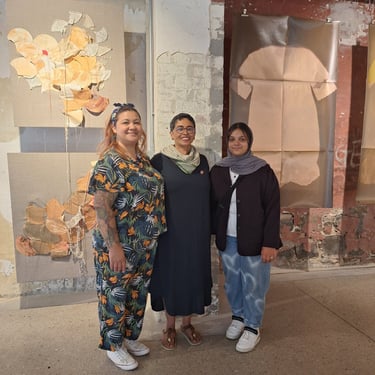
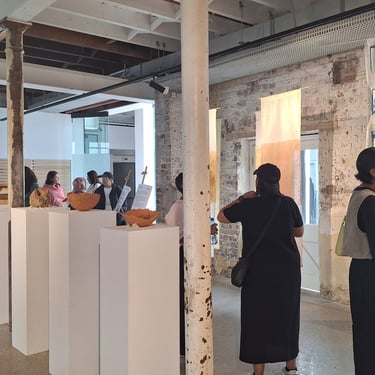
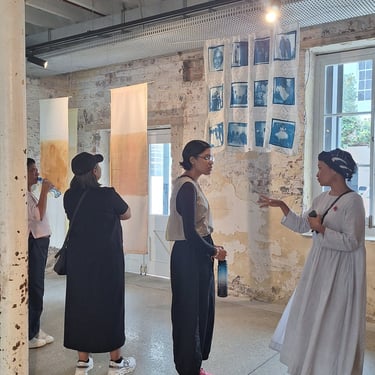
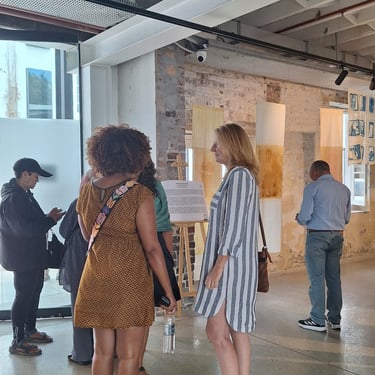
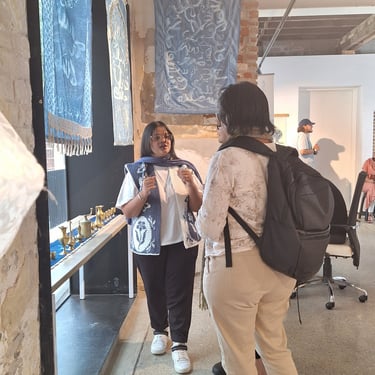
This exhibition, featuring artists Ni-shaat Bardien and Shalner Ching, is about the duality of being broken, but also being in the process of becoming, a tension between rapture and reconstruction. To be fragmented is to be split, divided or displaced. But to be augmented, placed within the parentheses of this exhibition's title, is to be enhanced, transformed or reconstituted with new meaning and value. The objects in this exhibition that have been previously damaged or broken, go through a type of metamorphosis. They go from being in a state of being vessels of nostalgia to becoming carriers of radical inheritance.
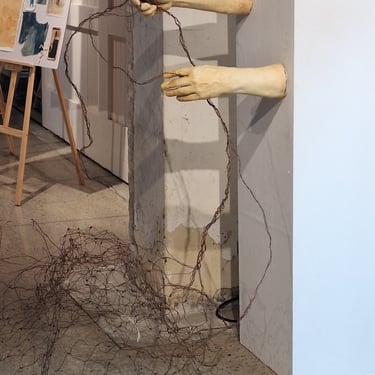
The exhibition title highlights two states: fragmented, being broken but enhanced by the augmented, a transformative process that embraces growth, not in spite of loss, but through it. Doilies and bath sheets, remnants of curtain netting and fishing net are materials that once served, once held and once adorned. Now reconfigured, they take on new functions: not of utility, but of memory and resistance. The domestic becomes political and the simple becomes monumental. Both artists, Bardien and Ching look at domestic objects and remnants to reconstruct a public history.
Bardien intentionally replicates domestic tasks in her artistic processes to challenge the hierarchies of labour, gender, and memory that exist within both the home and the archive. By transforming activities traditionally associated with femininity, such as sewing, folding, cooking, and cleaning into ritualized artistic practices, she counters the marginalization of women’s labour in official narratives. In this way, Bardien blurs the lines between the private and public realms, redefining these intimate spaces as a medium for collective memory.
Ching draws upon historical objects to enrich her artistic practice. From fishing nets to clay and debris discovered in District Six, she utilizes these items not as mere passive materials, but as active witnesses that become repositories of lived experiences, displacement, and cultural continuity. Her choice of site-specific remnants is deliberate as these materials do not merely symbolize memory; they embody it. Interwoven within the physicality of her creations are the textures of dispossession and resilience, the essence of community, and the material traces of what once represented home.
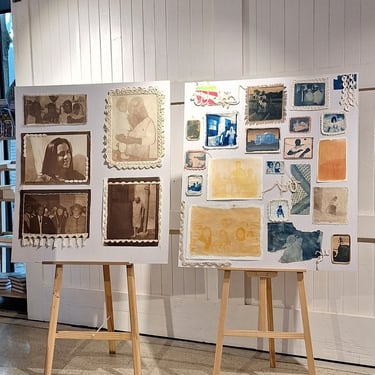
Both of the artists focus on communal authorship, achieved through their collaboration with parents, fishermen, elders, and other community members. They not only utilized salvaged materials but also uncover narratives that had been hidden for various reasons, including the emotional burden of recalling history. What sets this body of work apart is that the artworks were not specifically created for the gallery; instead, they were drawn from a living archive that embodies intergenerational knowledge, ritual care, and cultural resistance.
Due to South Africa's tumultuous history and the experiences of its communities in the wake of post-apartheid, both artists faced challenges in constructing a comprehensive narrative of their origins which honoured their families and communities. Their stories were often comprised of fragmented histories, tales, and memories. Similarly, the exploration of materiality in their search for historical truth mirrored this fragmentation. Both oral and archival narratives, along with material history, presented obstacles that made drawing definitive conclusions difficult. Consequently, the artists embraced this fragmentation in a poetic way within their work. They skillfully assembled what they could find, creating beautiful pieces that emphasized the struggle of engaging with broken narratives and shattered objects.
Fra(u)gmented invites viewers to reconsider the notion of wholeness in a world characterized by rupture. Through the artistic expressions of Bardien and Ching, this exhibition challenges the perception that fragmentation equates solely to loss. Instead, it suggests that these breaks can provide fertile ground for transformation, memory, and resistance. It emphasizes that within these fragments exist the foundational elements for a profoundly connective experience that defies erasure and celebrates existence.
CURATORIAL
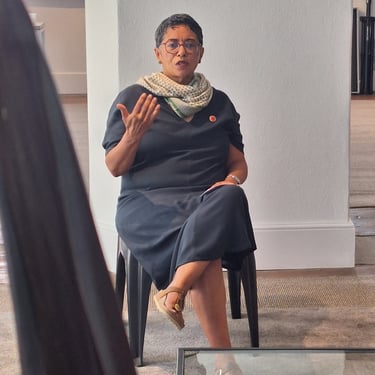
by Head Curator Aaliyah Ahmed
SET DESIGN
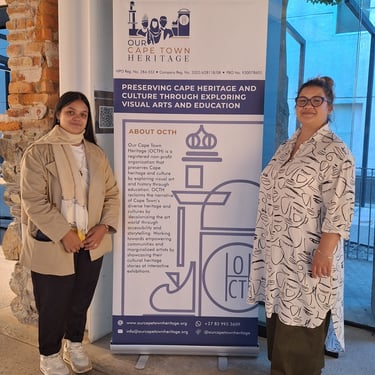
OCTH Curatorial Assistant: Zoku Mgoduka-Horn
OCTH Curatorial Assistant: Zainab Abrahams
Cape Town’s garment industry has played an integral role in shaping the city’s economic and cultural landscape, and was one of the few sectors within South Africa that employed more women in its workforce.
The industry had a late start in 1925, as local clothing manufacturers could not keep up with cheaper imports coming from Great Britain. However, after 1925, the Pact government imposed tariffs on all imported goods, including clothing, which increased their prices. This allowed local clothing factories to produce and sell clothes to the local market, resulting in profitability. The clothing sector in South Africa during the first quarter of the 20th century was the first to enforce import substitution — the process of replacing imported goods with locally manufactured ones.
However, on a deeper level, the Pact government wanted to ensure that the increase in profitability in the clothing sector could also support job creation for white workers, who could then be paid “civilized” wages. This ideology strengthened the racial and political agenda of the government, in that it enforced structures that benefitted the white community while excluding and disadvantaged Black and Coloured communities.
The social sphere of garment workers within South Africa varied starkly between regions, largely due to the differing relationships between unions and manufacturers. The Western Cape branch of garment workers — and particularly those in Cape Town — faced different experiences to those inland, notably in the Transvaal region. Cape Town garment workers, under the leadership of Robert Stuart from the Cape Federation of Labour Unions, were forcibly enlisted into unions that were employer-sympathetic. This meant that unions were more aligned with the interests of garment factories, rather than the concerns of floor workers, resulting in little to no strike action around wage disputes. In contrast, the northern Transvaal unions, under the leadership of E.S. Sachs actively engaged in strikes for better wages — which resulted in workers being paid thirty to forty percent more than Cape Town workers.
There is further contrast between the two regional unions in terms of racial bias. The Garment Workers’ Union of the Cape Peninsula practiced non-racialism, including and representing all races within its organization. The Transvaal branch, on the other hand, maintained a racially exclusive policy that did not allow Black members at all. While the union did accept Coloured workers, they were moved to different branches, which excluded any white members.
Racial segregation thus became a dominant theme in apartheid-era South Africa, where the ideology was pushed to separate different races. During the 1930s and 1940s, the industrial workforce within the Cape was one of the main sectors where racial segregation was formalized and became the norm. In 1918, the first legislation governing the operation of factories — the Factories Act No. 28 — was passed.
However, this act did not explicitly stipulate that workers of different races had to be segregated. It was amended in 1931 to include the somewhat ambiguous statement that separation between whites and non-whites be exercised:
“...when in the opinion of an inspector conditions exist in a factory which lead to undesirable contact between persons of different races or sexes.”
However, this proved unsatisfactory to white workers, and in 1941 the matter was taken up again to ensure proper measures were put in place. One such panicked remark read:
“We cannot maintain our white civilization if the present bad conditions continue in our factories. We are pleading with the Minister to reconsider these serious questions... White South Africa demands it.”
By the 1960s, the Rex Trueform factory in Salt River was already a well-established clothing manufacturing plant — one that held a certain standard in how it presented itself to the public. The workforce in the clothing sector in the Western Cape during this era was mostly female and Coloured, amplified by the Coloured Labour Preference Area policy, which aimed to make the Western Cape a predominantly Coloured workforce. Due to limited upward mobility in terms of job opportunities and education, the Coloured female became a prime target for garment factories, who exposed them to low-wage work. This is what is termed “triple oppression” — where a person is female, of colour, and a worker.
Viewed through a humanist lens, the history of the garment industry in South Africa is one of resilience amid systematic inequality. It showcases how women of colour had to navigate racial, economic, and gendered oppression during an era when South Africa was at its most tumultuous. It speaks not only of struggle but of the ongoing fight for dignity and recognition within the industrial landscape.
THE ARCHIVES
by Archival Researcher Yunus Ogier

Discover
Contact Us
Our cultural heritage matters
Help us learn and grow by sharing your respectful feedback on our website, exhibitions, social media and more:
Store's Terms and Conditions